The network
Open routes between real airports. Concentrate them on one hub and the bonus climbs — two routes are worth +6%, four are worth +24%, seven hit the +50% ceiling. Spread yourself thin and you get nothing.
Hub bonus AEROCEO
Simulation · Airline management · iOS
Buy real aircraft — ATR, Embraer, Airbus, Boeing. Open routes between real airports, set your fares, and the engine keeps the airline flying after you close the app.
| Route | Aircraft | Load factor | Net / day |
|---|---|---|---|
| CDG → JFK | A350-900 | 91% | +$412K |
| CDG → DXB | 787-9 | 78% | +$236K |
| CDG → LIS | A320neo | 96% | +$88K |
| CDG → NCE | ATR 72-600 | 41% | −$12K |
| CDG → SIN | 777-300ER | 83% | +$301K |
Example airline — figures produced by the game engine.
What you run
There is no win button. There is a network to build, trade-offs to hold, and a fleet wearing down while you do it.
What you build
Open routes between real airports. Concentrate them on one hub and the bonus climbs — two routes are worth +6%, four are worth +24%, seven hit the +50% ceiling. Spread yourself thin and you get nothing.
Hub bonusJoin the alliance and earn ranks across three branches — Flight Operations, Network, Management — awarded automatically as you hit the milestones. Thirty-day season campaign.
OptionalWhat you decide
Price every route against a demand curve. The screen shows you the optimal fare and what an overpriced seat costs you in load factor. A full aircraft at a low fare usually beats an empty one at a high fare.
Yield managementYour board of directors sets fifteen-day mandates with real targets. Restructure the airline and you unlock a tree of permanent upgrades across three branches.
Mandates & legacyWhat wears you down
Airframes wear by the kilometre. Below 30% condition an aircraft is grounded and its fuel burn climbs by up to 75%. The hangar repairs the whole fleet from one screen — or you keep a crew on standby and it handles itself.
Real wearNine lessons teaching the game's actual economy — hub bonus, route maturity, fuel and crew costs — quoting the exact figures the simulation uses. Not a tutorial: a manual.
3 modulesIn game
Eight screens, and the engine figure each one puts in play.

Six regions to unlock, one market each.

The optimal fare against the demand curve.

Below 30% condition, the aircraft stays grounded.

23 real aircraft, from the ATR 72-600 to the 747-8.
Fuel, crews, airport fees — line by line.

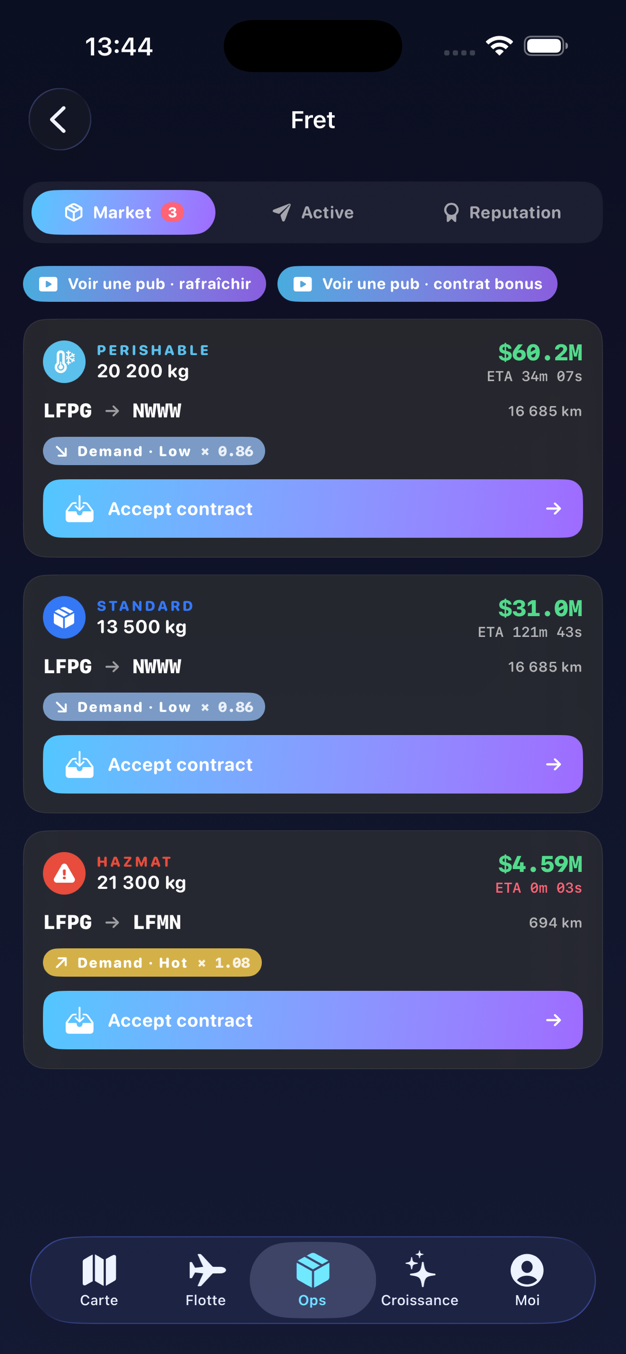
Freight to load when the cabin isn't enough.

Fifteen-day mandates set by the board.

Three rank branches, a thirty-day season.
Under the hood
These aren't ballpark figures invented for a marketing page: they're the constants the engine applies to every flight, and the in-game school teaches them to you.
Hub bonus ceiling, reached at seven routes on the same airport. Four routes are worth +24%, two +6%.
Grounding threshold. Below it the aircraft stays on the ground and its excess fuel burn climbs by up to 75%.
Aircraft types, from the ATR 72-600 to the 747-8 Intercontinental, each with its own range, cruise speed, capacity and fuel burn.
Regions to unlock — Europe, the Americas, Asia, Africa, Oceania — each opening its own market.
Cleared for departure
Free, no subscription required, and your fleet keeps flying after you close the app.
Download on the App Store